Quick Facts
| Detail | Information |
|---|---|
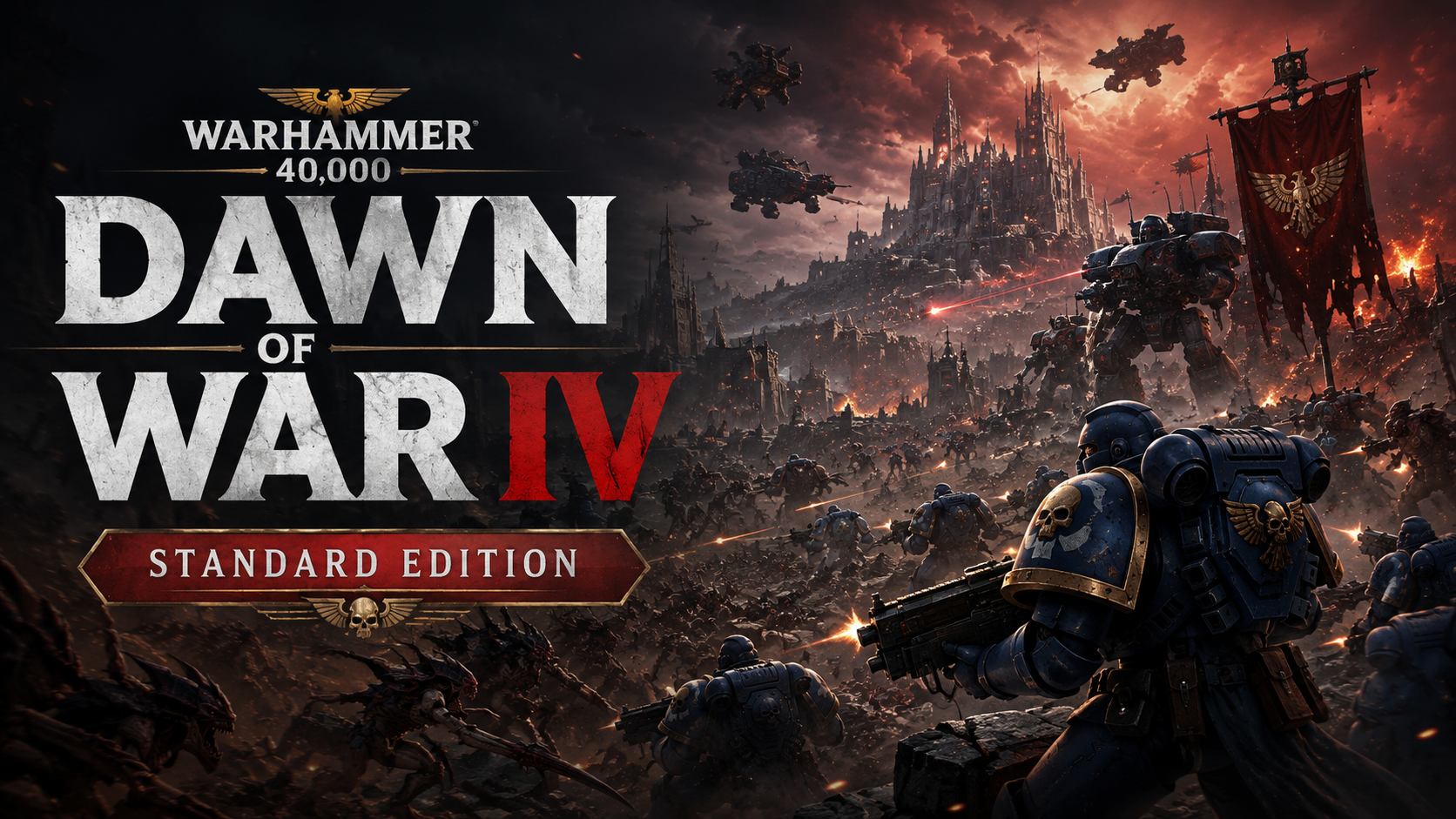
| Game | Warhammer 40,000: Dawn of War IV |
| Edition | Standard Edition |
| Release Date | September 17, 2026 |
| Platform | PC via Steam |
| Developer | KING Art Games |
| Publisher | Deep Silver |
| Genre | Real-Time Strategy |
| Get It at Gamers-Outlet.net | Buy Dawn of War IV Standard Edition PC Steam Key |
Dawn of War Is Finally Going Back to What Made It Great
Dawn of War IV launches on September 17, 2026, and everything shown so far suggests that KING Art Games understands why the original Dawn of War became so important. Base construction is back, territory matters again, squads can be upgraded and preserved between engagements, and battles appear to focus on large armies rather than a small number of hero units dominating every encounter.
That direction is important after Dawn of War III divided the community with its heavier focus on elite units and multiplayer systems that did not always feel like a natural continuation of the series. Dawn of War IV appears to be looking further back, taking the foundation of the 2004 original and refining it for modern strategy players rather than chasing a completely different audience.
The Standard Edition provides access to the complete core experience without requiring an immediate commitment to every planned expansion or digital extra. For many players, that will be the most sensible way to return to Kronus. I bet Henry Cavill is giggling in a corner, excitedly waiting for it to release.
Four Factions That Actually Play Differently
Faction variety is essential in a good real-time strategy game. Different armies should not feel like recoloured versions of the same units, and KING Art has repeatedly emphasized that each Dawn of War IV faction is being built around its own strategic identity.
The Space Marines rely on elite troops, careful positioning, reinforcement, and mobility. Their individual squads are powerful, but they are expensive to replace, meaning players are encouraged to preserve experienced units rather than throwing them into every fight.
Orks take the opposite approach. They spread across the map, built multiple strongholds, raise Waaagh! Banners, and overwhelm enemies through pressure and numbers. Losing an individual unit is far less damaging when another mob is already charging toward the same objective.
Necrons depend on regeneration, teleportation, and a Power Matrix that spreads influence across the battlefield. Their armies can recover from punishment that would destroy another faction, but their unusual infrastructure should require careful preparation before that strength becomes overwhelming.
The Adeptus Mechanicus use a Noosphere Network linking structures and supporting their technologically advanced forces. Their strategy appears to revolve around efficient positioning, mechanical synergy, and gradually bringing increasingly terrifying machinery into the battle.
This asymmetry gives the campaign more replay value and should make competitive multiplayer far more interesting than simply learning one universal build order.
Base Building, Resource Control, and Proper RTS Warfare
Dawn of War IV brings back a more traditional strategy loop built around construction, expansion, resource points, army composition, and battlefield control.
You will build bases, capture territory, improve resource locations, specialize squads with new weapons, and use cover or garrisoned buildings to keep units alive. Veteran troops become stronger as they survive battles, creating an incentive to retreat when necessary rather than treating every squad as disposable.
The game also introduces a Combat Director system that develops the older Sync Kill concept. Units react dynamically when they clash, producing brutal close-range engagements and faction-specific finishing animations without removing control from the wider strategy layer.
This matters because Dawn of War has always been good at making a strategy match feel like an actual Warhammer battle. Squads do not simply stand at a distance and reduce numerical health bars. They collide, fire into crowds, charge defensive positions, and turn ordinary resource points into scenes of complete destruction.
Early hands-on previews have been positive about this return to the series’ foundations. Several outlets have described the game as closer to the sequel fans originally wanted from the first Dawn of War, while still modernizing controls, visuals, faction design, and campaign structure.
Of course, the final game has not released yet, so there are no genuine post-launch player reviews available. The early response is encouraging, but performance, balancing, multiplayer stability, and long-term progression will only become clear after September 17. Of course, since Deep Silver is involved, I doubt it would be disappointing, so hopes are high and passions are higher 😀
Campaign, Last Stand, Skirmish, and Multiplayer
The Standard Edition may contain only the base game, but the base game itself is not a small package.
The four faction campaigns and more than 70 missions provide the main single-player experience. Skirmish allows players to create battles against AI opponents, while competitive multiplayer supports warfare against other commanders. Steam also lists online cooperative play, giving friends additional ways to experience the game together.
Last Stand is returning as well. This fan-favourite mode places players under growing pressure and challenges them to survive increasingly dangerous waves. Dawn of War II players may remember Last Stand for its replayability, character progression, and ability to turn a short session into several hours of trying new combinations.
KING Art and Deep Silver have also confirmed free post-launch additions. Planned updates include Crusade mode, new maps, a mission editor, and additional Commander scenarios. Some premium content will be sold separately, but Standard Edition owners are not being excluded from every future addition. That makes the basic version more appealing for players who want to experience the complete launch game first and decide on paid expansions later.
Standard Edition or Commander Edition?
The Standard Edition includes the complete base game and currently carries a pre-order discount through participating official storefronts. It does not include the Blood Ravens Story Prologue, the planned Aftermath campaign expansion and additional faction, or the digital soundtrack.
Those extras are included with the Commander Edition, alongside three-day early access.
The correct choice therefore depends on how committed you already are. Long-time fans who know they want the Year One premium content may see value in the larger edition. Players who mainly want the campaigns, multiplayer, Skirmish, and Last Stand can choose Standard Edition without paying upfront for content arriving later.
There is nothing incomplete about beginning with the base version. More than 70 campaign missions, four mechanically distinct factions, several multiplayer and cooperative modes, and free post-launch updates already create a substantial package. Ask yourself if you even have the time to play all of this!
Deal Spotlight: Buy Dawn of War IV Standard Edition at the Best Price
Players ready to return to Kronus can buy Warhammer 40,000: Dawn of War IV Standard Edition PC Steam Key through Gamers-Outlet.net.
Check the listed region, platform, release status, and delivery information before completing the order. This product is the Global Steam version of the Standard Edition and includes the base game rather than the Commander Edition extras.
Gamers-Outlet currently holds a 4.6 out of 5 Trustpilot rating from more than 43,000 customer reviews. I think that says a lot about our service and how hapy our customers are 🙂